
Sailing, our series
Racing On The Edge
450
hours per hour on screen
210 hours behind each 26-minute episode, 2026
Production Intelligence
Production Intelligence is our story consultancy. We help leagues, teams and brands turn great access into stories worth caring about.
An hour of our time, free, by video or in Bristol.
Access gets you into the room. What matters is what you find there: who can carry a series, what it’s really about, and what a small crew has to be there for. Without that, great access turns into generic content. Highlights reach the fans you already have, and new audiences need someone to follow before they’ll follow a sport.
A modern sports production records more than anyone can watch: interviews, race comms, onboard cameras, team feeds and broadcast, every day of a season. So most edits begin from memory: whatever someone remembers, or had time to log. The line that turns an episode is often in the third hour of comms, or the minute after an interview officially ended, and under deadline it’s rarely found. That costs days, and it can cost the better episode nobody knew was there.
Production intelligence closes that gap with two things that seldom sit together: the judgement of directors who know where stories hide, and recall of every word your production has recorded.
New and growing leagues and events
You need an audience quickly, and nobody knows your athletes yet.
Teams within a league
You have strong characters, generic content, and league rules on what you can film and use.
Story & Format, then Story Reviews
Brands and sponsors
You have access to athletes or teams through a sponsorship, and no story to tell with it.
In-house content teams at any of these
You have a small crew, too much footage and slow edits.
Often hundreds of hours. Drive to Survive’s latest season was cut from almost 250 hours of material for every hour on screen. At that rate, one person would need more than four working weeks just to watch each episode’s material once. On Racing On The Edge, an episode gets about 15 days in the edit. We make every word of that material searchable before the edit starts, so your decisions draw on all of it.
Sailing, our series
450
hours per hour on screen
210 hours behind each 26-minute episode, 2026
Formula 1
250
hours per hour on screen
Almost 1,500 hours for 8 episodes, 2026
NFL
250
hours per hour on screen
More than 250 hours a week for a one-hour show, 2012
Football
60
hours per hour on screen
About 30 hours behind each 30-minute episode, 2023
Hours of material per hour on screen. Material includes archive, which is why the films run far higher than the series.
Hours of material as reported by each production’s makers or the press, divided by running time and rounded. Sources: Formula 1 and TV Guide for Drive to Survive; SVG for Hard Knocks; TVBEurope, the editor’s own estimate, for Welcome to Wrexham; the Senna archive masterclass; /Film for The Last Dance; NYFA for Free Solo; IDA for Diego Maradona; Wikipedia, citing The New York Times, for Hoop Dreams.
Each is scoped and priced before we start. Take one, or let them follow your series from first idea to final cut. We take on a limited number each season.
Find the story
For when you have remarkable access and no series yet.
We spend time with your people, at work and, with their agreement, away from it, and interview each of them one to one. We’re looking for what a series runs on: someone who wants something badly and might not get it, a relationship under strain, the gap between how people present themselves and how they act when it counts. Then we tell you, plainly, who can carry a series, what it’s really about, and which format and audience will hold it.
Two to three weeks for the first stage, and three to four more if you go further. You can stop after the first stage.
CHARACTER MAP · DISCOVERY
Who matters, and why
The captain
Wants one more title before his body gives out.
Collides with the owner, who is already talking to his replacement.
The rookie
Wants the seat, and to be trusted in it.
Collides with the captain, who taught him everything he knows.
The strategist
Wants to be believed again after last season’s call.
Collides with a captain who still overrules her when it counts.
Get it on camera
For when the story depends on what one person is willing to say.
The interview is the most valuable hour in a production, and the easiest to waste. Athletes are interviewed every week and know what they’re expected to say; the story is in what comes after. Ours are conducted by our directors. Borja Cantera’s interviews are known across SailGP for reaching what athletes rarely say on camera, and Cécile Embleton co-directed the Grierson Award-winning Mother Vera. We prepare from everything you’ve already recorded, so every question goes after something the story still lacks.
Book a single interview or a season of them. Our directors take on only a few each season.
INTERVIEW BRIEF · EPISODE 4
Topics, never words
Prepared from what’s already recorded. The answers are hers.
Make it findable
For when you know what you’re making and need a way to make it with a lean team.
A lean crew can’t film everything, so it has to know what only it can capture. We plan coverage around your characters: what your crew must film, and what can come from broadcast, onboard and team feeds once it’s clear who owns them. Then we design the edit so every interview and every line of comms is transcribed, labelled and searchable by what was said, and a first structure can be built from real dialogue.
Take the filming side, the edit side, or both.
RIGHTS MAP · SEASON ONE
Checked before we quote
Footage, comms and feeds often belong to a league or broadcaster. We find out before anything is processed.
Keep it on course
For when you’re making a series, yourselves or with a production company, and want a senior story eye at the moments that decide it.
There are three. Before the shoot, while you can still change what you’ll film. During it, when the material shows whether the premise is holding. And in the edit, when the sync pool, paper edit or cut either finds the story or buries it. We come in at those points with clear notes and, where it helps, another way through. Your director and editor make the calls.
STORY REVIEW 3 OF 5 · ROUGH CUT
Your director decides
Written notes, then a live session. Your director and editor make the calls.
SoftwareYou’re buying our judgement and a method your team can run. There’s no product to license.
Edit suites or storageWe won’t buy kit for a client. If you need suite time and ours is free, we’ll quote a day rate.
Running your workflow week to weekWe set it up and train your people to run it.
Story consultancy for other production companiesWe’re one ourselves, and they’d be right to think twice about showing us their cuts. If you’ve hired one, we work with it on your behalf.
An hour of our time, free, with nothing to prepare.
We make Racing On The Edge for SailGP, in partnership with Rolex. Borja joined in its second season, and we’ve delivered 40 episodes since 2022, each cut while the season is still being decided. It goes out on international broadcasters and online, including SailGP’s YouTube channel, and SailGP reports more than 10 million viewers since the series began in 2021.
Thirteen teams, a calendar of events around the world, and a small crew: a director who also conducts the interviews, one or two camera operators close to the athletes, and broadcast, onboard and team feeds for the racing itself. On one episode the film grew “six minutes a day: six on Wednesday, twelve on Thursday, eighteen on Friday, twenty-four by Monday, when the rough cut went off to SailGP.”
A season like that teaches you things a single film can’t. Five of them shape how we work.
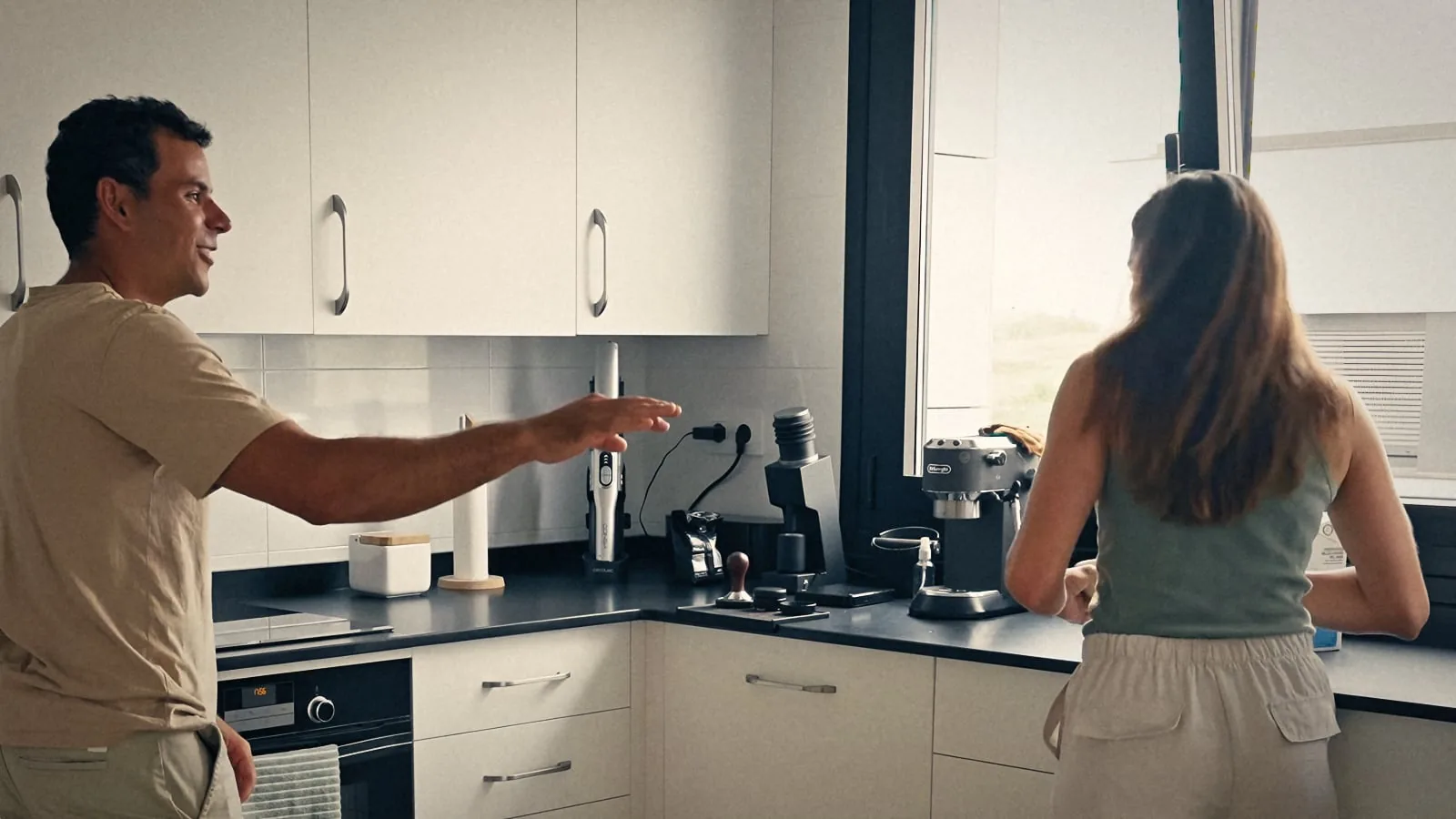
“People don’t say those things to a camera. They say them to a small crew they’ve come to trust, and only when they know it will be handled with care.”
Borja Cantera on Empathy
Fame doesn’t carry a series. The athlete everyone knows can be the hardest to film honestly, while the one fighting for a place can carry a season.
“Leo doesn’t talk much about fear, so we had to find places where you could see it. After the collision in Perth, we filmed him going up in a tiny plane with his dad and Blair. On paper it’s a day off. On screen it’s the whole film.”
Borja Cantera on Flight at Breaking Point, about the championship’s youngest flight controller
Everyone has already seen the result. The decisions around it take days to play out: who’s dropped, who speaks up, who takes the blame. They need a camera in the right room.
“After Copenhagen they sit down and ask themselves whether to change the person at the wheel, and the answer is no. Loyalty is a decision too.”
Borja Cantera on Red Wall, season 3
By mid-season a production has captured more than anyone can remember, and the moment that turns an episode is often one nobody logged: a line in the race comms, a half-sentence at the end of an interview. So we make every word searchable.
“We went through hours of onboard audio for the tiny human things that decide a race: a teammate breathing into an open mic, a countdown nobody hears.”
Borja Cantera on Empathy
In our edits, each line carries one of three labels. Captured: said on camera and checked against the recording. Scripted: written for a presenter or commentator to approve and record. Gap: a story point we don’t have yet, which becomes a topic for the next interview and never words for a contributor to say.
Contributors answer a person. The same question from a different interviewer draws a different answer, which is why our directors conduct the interviews themselves.
01
An hour of our time, free and in confidence, by video or in Bristol. You tell us what you want to make and where it’s stuck, and we tell you honestly whether we can help. We don’t review material yet, so there’s nothing to prepare, and you’re not committing to anything.
02
Within a week, if we can help: the problem in your words, one or two options, a fixed fee, what’s included, what we need from you, and dates. Every proposal states its limits, so you know exactly what you’re buying. If we’re not the right people for it, we’ll say so and suggest who might be.
03
An NDA, our terms and a statement of work come first. One of us then leads your engagement and is your single contact, bringing in a researcher or assistant editor where it helps. We agree the confidentiality and material-sharing arrangements for your project before reviewing client material.
04
The written work, a live session to talk it through, and a follow-up call a month later. You own what you pay for and can use it with any producer. If you’d like us to make what we’ve designed, that’s a separate conversation with P1 Entertainment, and never a condition.
Most productions have good people, and more and more have AI. Few have the two working as one. That’s what our practice is built on.
Our directors bring what no model has: the instinct for who carries a story, and the trust that gets people to tell it. Our method brings what no person has: recall of every word your production has recorded, searchable by what was said. The method shows our directors what the story still lacks. Our directors decide what matters, and go and get it.
Every line the method proposes links back to the moment it was recorded, and an editor checks it before it goes near a cut. We compare what it proposed with what made the final cut, and carry the difference into the next episode.
One of us leads every engagement in person, from first conversation to handover.
Founder, executive producer and series director
A British-Spanish former BBC producer-director, Borja leads Racing On The Edge, which he joined in its second season, and across SailGP he has become the interviewer athletes open up to. He co-created and directed McLaren’s World’s Fastest Gamer and directed several series of GT Academy, whose wider campaign won Gold and Bronze at Cannes Lions, with further credits for the BBC, Amazon Prime, Discovery and Red Bull.
Director
Cécile is a British-French documentary director. Her feature Mother Vera, co-directed with Alys Tomlinson, won the Grierson Award for Best Documentary at the BFI London Film Festival, and her debut, The Watchmaker, screened at Hot Docs, DOK Leipzig and SXSW. She also shoots and edits, and works in English, French, Spanish and Italian.
Head of post-production
Tom runs post-production and delivery at P1, from the first assembly to the final deliverables.
We bring in a researcher or assistant editor where it helps. They support the person leading your engagement, and they never replace them.
If yours isn’t here, ask us directly.
We can. P1 Entertainment is a production company, so if you’d like us to make what we’ve designed together, we’ll quote for it separately. You’re never obliged to. You own the work you pay for and can take it to any producer.
The director who leads your engagement is named in the proposal and stays with it to the end. Researchers and assistant editors support our directors, and they never replace them.
You do. We keep our own methods and templates. If we develop something that could work beyond your organisation, we agree who owns it before we start.
Every engagement is priced as a fixed fee, agreed before we start, and Directed Interviews are booked by the session. After a first conversation, we’ll send a proposal with a price. Half is due on signing and half on delivery, on 30-day terms, and travel and accommodation are charged at cost.
That’s common. Footage, comms and feeds often belong to a league or broadcaster, and broadcasters increasingly set their own rules on AI. We check who owns what before we quote, and we write it into the proposal.
We sign an NDA before reviewing confidential client material and agree suitable sharing arrangements. Ask us about the handling and retention requirements for your project.
Yes. If you’ve hired a producer, we’ll work alongside them on your behalf, usually through Story Reviews or Directed Interviews.
Yes. Your crew films on location and our director joins live, so a contributor in Sydney and a director in Bristol can still have the conversation that matters. If you’d rather we were in the room, we’ll travel.
Mostly, because that’s where our experience is. But the same questions apply wherever people are under pressure and someone has access to them.
Adobe Premiere. If your team cuts on something else, we’ll tell you plainly what carries over.
In Bristol. We travel to wherever your people are, and for Directed Interviews we often don’t need to.
Book a first conversation: an hour, in confidence, with nothing to prepare. If we can help, you’ll have a proposal within a week.
bristol@p1entertainment.com